


What Is Harpers Ferry Famous For?
Tucked into the rugged hills where three states meet, Harpers Ferry packs as much history per square mile as almost anywhere in America. This tiny West Virginia town has witnessed a radical abolitionist’s last stand, seen armies clash over its strategic heights, and served as a launching pad for the civil rights movement, all set against some of the most dramatic river scenery on the East Coast.
From John Brown’s raid on the federal armory to fierce Civil War battles to its modern role as an Appalachian Trail hub, Harpers Ferry offers layers of stories waiting to be explored. Ready to walk where history happened? Book a cabin in Harpers Ferry and make this historic town your home base for adventure.
Harpers Ferry’s Unique Location and Early Origins
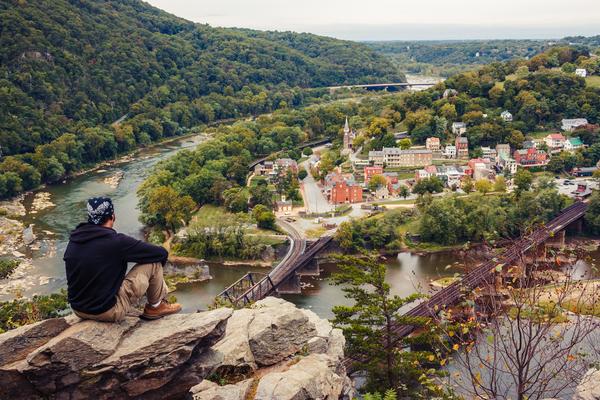
Harpers Ferry sits at one of the most striking geographic junctions in the eastern United States. Located in Jefferson County in West Virginia’s Eastern Panhandle, the town perches on a narrow point where the Potomac and Shenandoah Rivers meet, merge, and cut through the Blue Ridge Mountains. Stand at the right spot, and you’re looking at three states: West Virginia, Virginia, and Maryland.
From Ferry Crossing to Permanent Settlement
The area’s first European settler was Peter Stephens, a trader who established a primitive ferry operation around 1733. In 1747, a Philadelphia millwright named Robert Harper saw its potential and purchased the land. By 1761, he had established a reliable commercial ferry across the Potomac River, and the town that grew around it took his name.
A Landscape That Captured America’s Imagination
Thomas Jefferson visited Harpers Ferry in 1783 and was so moved by the view that he declared it “one of the most stupendous scenes in nature.” He described the Potomac River bursting through the mountains as worth a voyage across the Atlantic to witness. His words helped cement Harpers Ferry’s early reputation for breathtaking natural beauty.
Geography That Shaped History
That same geography—the rivers, the cliffs, and the natural gap through the mountains—would soon make Harpers Ferry essential for industry, transportation, and eventually, war.
The Federal Armory That Put Harpers Ferry on the Map
Harpers Ferry’s national importance skyrocketed when George Washington selected it as the site for one of the country’s first two federal armories. Washington recognized that the waterpower from the Shenandoah Falls and Potomac River could drive the machinery needed to manufacture weapons at scale.
The federal government purchased land along the Potomac in 1796, and construction began in 1799. By the early 1800s, the United States Armory and Arsenal was in full operation, producing firearms for the young nation’s military.
The armory pioneered manufacturing techniques that would reshape American industry. It became the first place in the world to successfully implement interchangeable parts in weapons production—a revolutionary concept that attracted engineers and skilled mechanics from across the country.
By the 1830s, transportation infrastructure transformed the town into a major hub. The Chesapeake & Ohio Canal reached Harpers Ferry from Washington, D.C., in 1833, and the Baltimore & Ohio Railroad arrived in 1834. The town soon boasted the first railroad bridge across the Potomac River and became a critical junction point linking east and west.
This concentration of federal weapons, transportation networks, and industrial power made Harpers Ferry an irresistible target, first for John Brown in 1859, then for both armies during the Civil War.
John Brown’s Raid: The Event Harpers Ferry Is Best Known For
Harpers Ferry is most famous for one night in October 1859 that helped push a divided nation toward civil war. Radical abolitionist John Brown led a small band of followers in an audacious assault on the federal armory, hoping to seize weapons and ignite an uprising of enslaved people across the South.
Brown wasn’t interested in compromise. He believed slavery was a moral abomination that could only end through armed resistance. His plan was bold and desperate: capture the armory’s arsenal, distribute weapons to enslaved people, and spark a rebellion that would spread through the mountains and plantations of the South.
On the night of October 16, 1859, John Brown’s men—21 in total, including free Black men and formerly enslaved people—crossed into Harpers Ferry and quickly seized the armory grounds. By morning, they held hostages and controlled key buildings.
But the uprising Brown hoped to trigger never materialized.
Local citizens and militia surrounded the raiders by October 17. The next morning, U.S. Marines under Colonel Robert E. Lee and Lieutenant J.E.B. Stuart stormed the engine house where Brown had barricaded his remaining followers.
The fight was brief and bloody. Brown was wounded and captured. He was transported to nearby Charles Town, tried for treason against the Commonwealth of Virginia, murder, and inciting a slave rebellion. On December 2, 1859, he was hanged.
The raid failed militarily but succeeded in something Brown may have understood all along: it made compromise impossible.
In the North, many viewed Brown as a martyr who died fighting evil. In the South, the raid confirmed fears of Northern aggression and slave uprisings. Historians often point to John Brown’s raid as a direct accelerant toward the 1860 presidential election and Southern secession.
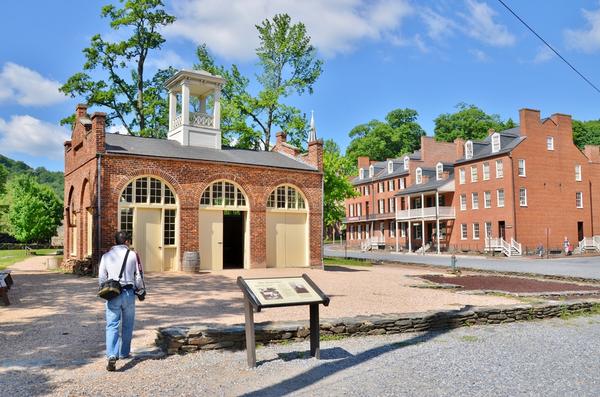
John Brown’s Fort, the small brick fire engine house where Brown made his last stand, still stands within Harpers Ferry National Historical Park. Visitors today can walk the armory grounds, view exhibits about the raid, and join ranger-led talks that bring that October night back to life.
Harpers Ferry in the Civil War
When Virginia seceded in 1861, Harpers Ferry instantly became one of the most contested places in America. Its armory, railroads, and position at the river gap made it a prize neither side could ignore… and neither side could easily hold.
The town’s strategic location came with a fatal flaw: it sat in a bowl surrounded by high ground. Confederate forces on Bolivar Heights, Loudoun Heights, or Maryland Heights could rain artillery down on anyone holding the town below.
Over the course of the American Civil War, Harpers Ferry changed hands more than a dozen times. Union troops burned much of the armory in April 1861 to keep it from Confederate hands, but Southern forces salvaged machinery and shipped it to Richmond.
The most significant engagement came in September 1862 during the Battle of Harpers Ferry.
Confederate General Thomas “Stonewall” Jackson surrounded the town and positioned artillery on the commanding heights. After a bombardment on September 14 and 15, the federal garrison surrendered. The result was staggering: approximately 12,419 Union troops laid down their arms, the largest surrender of U.S. military personnel until the Battle of Bataan in 1942.
The three heights surrounding Harpers Ferry tell their own stories:
- Maryland Heights: Directly across the Potomac, this ridge saw the first battle between Union and Confederate forces around Harpers Ferry and remained a critical observation point throughout the war.
- Loudoun Heights: To the south, this became an early Confederate stronghold where Jackson ordered infantry blockhouses built in 1861. Remnants are still visible on hiking trails today.
- Bolivar Heights: Just west of town, this ridge saw fortifications built by both sides and witnessed much of the 1862 fighting.
Modern battlefield preservation by the National Park Service allows visitors to walk these ridges, read interpretive markers, and see the sweeping views that made the town’s strategic importance so clear.
Harpers Ferry’s war-torn landscape, fortifications on the surrounding heights, and preserved streets make it a powerful place to understand the Civil War’s complexity along the border between North and South.
A Center for African American Education and Civil Rights
After the guns fell silent, Harpers Ferry reinvented itself as a center for African American education and early civil rights activism. The same town where John Brown died fighting slavery became a place where formerly enslaved people and their descendants built new futures.
Storer College opened in 1867 on Camp Hill, founded with support from the Freewill Baptists and federal Freedmen’s Bureau funds. It was one of the first schools in West Virginia dedicated to educating African Americans and became an early example of an integrated institution, admitting both Black and white students during the Reconstruction era. The college operated until 1955, training generations of teachers, ministers, and community leaders. But its most famous moment came in 1906.
That summer, W.E.B. Du Bois and other Black intellectuals gathered at Storer College for the second meeting of the Niagara Movement. They deliberately chose Harpers Ferry because of its connection to John Brown’s anti-slavery crusade. The movement they built there helped pave the way for the NAACP’s founding in 1909.
This combination of John Brown’s raid, postwar Black education, and early civil rights organizing makes Harpers Ferry a key site in the long story of African American freedom struggles. Visitors today can see surviving Storer College buildings on Camp Hill and find exhibits connecting Harpers Ferry to the broader civil rights movement in America.
Natural Scenery, Outdoor Recreation, and the Appalachian Trail
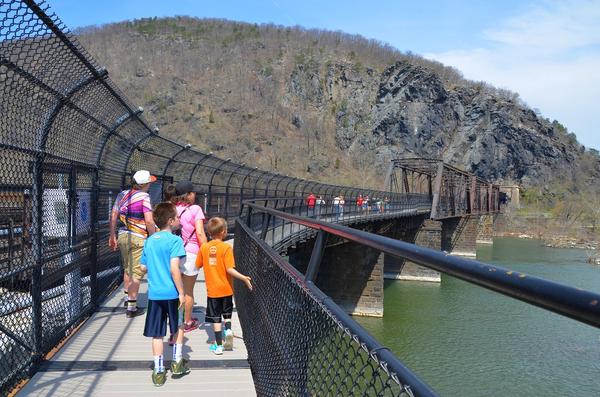
Beyond its layers of history, Harpers Ferry is famous for its natural beauty and status as a major outdoor recreation destination. The same dramatic landscape that drew Thomas Jefferson’s admiration now draws hikers, paddlers, pedalers, and photographers from across the country.
“The Point” remains one of the town’s most iconic spots. Stand on the rocky outcrop where the Shenandoah and Potomac Rivers merge, and you’re looking at three states and watching water carve through ancient mountains. It’s the view that earned Jefferson’s “most stupendous scenes” description, and it still delivers.
The rivers make Harpers Ferry a well-known regional destination for water sports, too. Local outfitters offer rafting, kayaking, tubing, and fishing for smallmouth bass in the Potomac and Shenandoah.
For Appalachian Trail thru-hikers, Harpers Ferry holds special significance. The town is often called the psychological halfway point of the 2,190-mile trail, and the Appalachian Trail Conservancy headquarters is located here. Long-distance hikers make pilgrimages to sign the register and take their photo in front of the famous AT sign.
Other popular hikes and views include:
- Maryland Heights Trail: A challenging climb rewarded with the classic postcard view of Harpers Ferry below
- Loudoun Heights Overlook: Civil War history meets sweeping river vistas on this less-crowded route
- Bolivar Heights Overlook: An easier walk combining 1862 battle sites with panoramic views
The same rugged terrain and narrow river gap that once shaped wars and industry now draw outdoor enthusiasts seeking adventure wrapped in history.
Stay and Explore Harpers Ferry
Few places in America let you walk through so many chapters of history in such a compact, beautiful setting. Harpers Ferry delivers Civil War battlefields, abolitionist history, civil rights landmarks, and stunning natural scenery, all within a few walkable miles.
Whether you’re drawn by John Brown’s legacy, the echoes of Civil War cannons, the pull of the Appalachian Trail, or simply the view from The Point, Harpers Ferry delivers an experience unlike anywhere else. Book your stay nearby and discover why this small West Virginia town has captivated visitors for over two centuries.


